
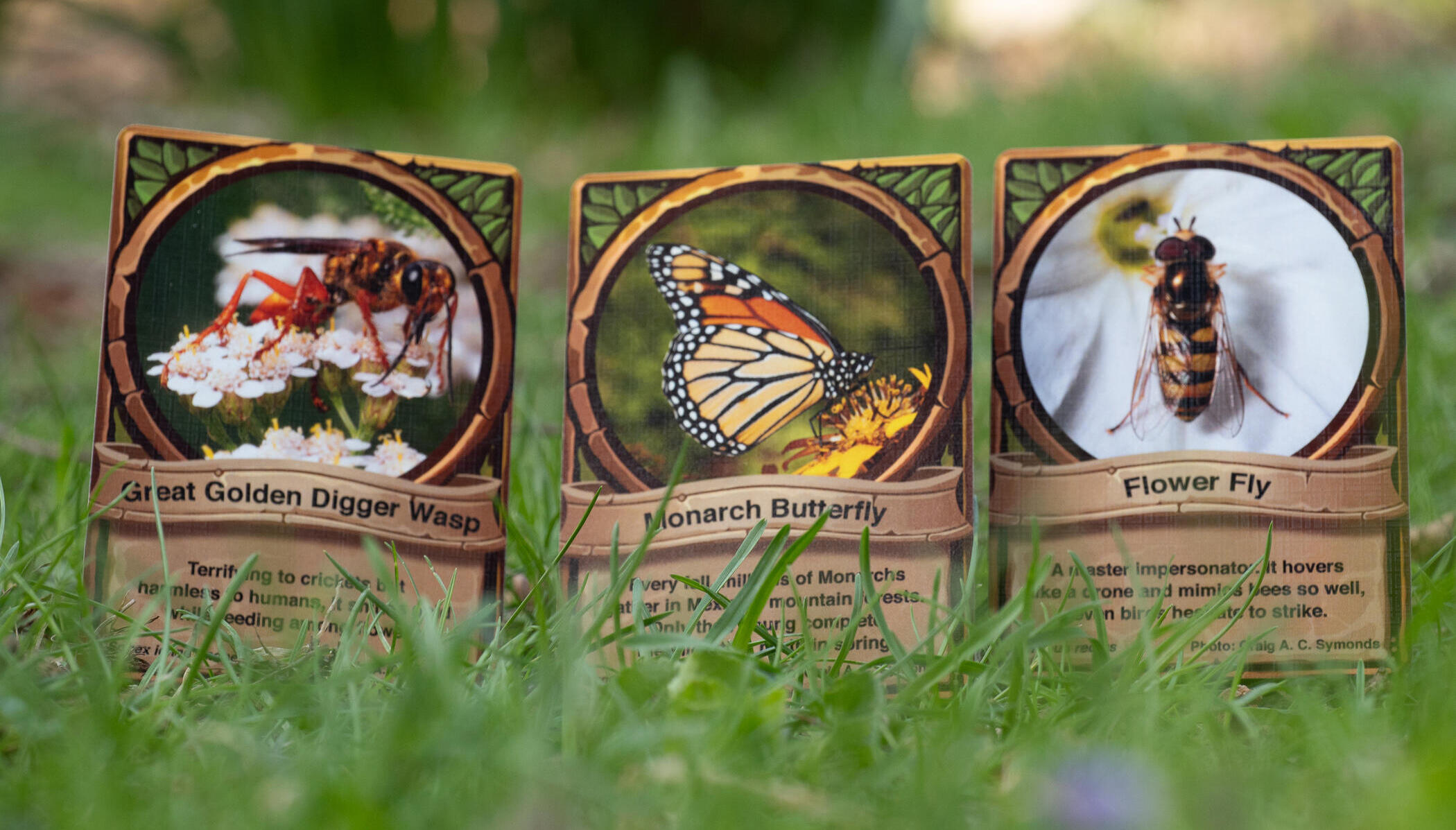
BASE SET: NATIVE BIODIVERSITYAvailable April 2026Featured Cards:
🔎 Click any card for a closer view!
Welcome to the world of Auraswarm!
Discover the magic of nature with Auraswarm Trading Cards — real-life collectible cards to inspire the next generation of wildlife champions! These 18 unique cards feature authentic macro photography of bees, butterflies, and other bugs from Southern Ontario, Canada. Whether you're learning about cute pollen foragers or fierce winged warriors, every card helps spark curiosity for the natural world.
Uncover the Secrets
Each Auraswarm Card reveals the lore and incredible abilities of these tiny heroes. Learn about the poison warnings of the Monarch Butterfly, the master disguise of the Flower Fly, the paralyzing sting of the Great Golden Digger Wasp, and much more!
Authentic TCG Feel
Auraswarm uses the same premium card stock as the world’s biggest card games, making them perfect for TCG fans. They're the same size and fit just right alongside the other cards in your collection!
Play Auraswarm!
Transform your Auraswarm Trading Cards into a cooperative storytelling game! One player narrates, while the rest play as their insects. Use real ecological knowledge from your cards to gain Insight Bonuses, guiding your bugs past survival to watch them thrive.

🔎 Click any card for a closer view!

Explore the hidden world right in your own backyard!
Auraswarm: Native Biodiversity shines a spotlight on the incredible native pollinators that keep Guelph and Southern Ontario blooming. Collect and play as these tiny Canadian heroes while learning fascinating facts about our local ecosystem. It’s an amazing, buzzing world just waiting to be discovered!
🔎 Click any card for a closer view!

"Where the Speed and Eramosa Rivers meet, two men from the Canada Company swung an axe into a maple tree on a spring morning in 1827 and called it a city. John Galt had the vision, and William 'Tiger' Dunlop — adventurer and larger-than-life character — had the spirit. Declaring to build a Basilica that would rival the greatest in Rome, the 'Royal City' grew from that single tree into a bustling community!The historic Ontario Agricultural College made this city a world centre for life sciences, laying the groundwork for what is now the University of Guelph. Today, that legacy thrives in The Arboretum, a massive wild zone open to the public that provides the ideal landscape for safely observing the natural world and the amazing creatures that sustain it.The region we call Guelph is deeply rooted in history. Since long before Canadian Confederation, it has served as the traditional lands of the Attiwonderonk and the Haudenosaunee on Turtle Island. Today, it remains the recognized treaty territory of the Mississaugas of the Credit First Nation, bound by the enduring Between the Lakes Treaty forged in 1792 with King George III.Now, Bugkeepers, it's time to meet the Pollinators that call Guelph home!"
- Loremaster Aster Solidago

Monarch CaterpillarA monarch caterpillar is a boldly striped munching machine! Milkweed is the only food it eats – and eating so much of it makes the caterpillar’s body poisonous to predators. In just a week or two of nonstop snacking, a monarch caterpillar can grow from a tiny hatchling to almost 2,000 times its initial weight. All that milkweed munching isn’t bad for the plant – it helps keep milkweed patches healthy and in balance, while fueling the caterpillar for its next stage of life.When it’s ready to transform, the monarch caterpillar wanders off to find a safe spot. There it hangs upside down in a J-shape and molts one last time, revealing a smooth green chrysalis. Inside this magic chrysalis, the caterpillar will metamorphose into a butterfly. By late summer, you can find these hungry caterpillars on milkweed in parks and gardens.

Monarch ChrysalisThe monarch chrysalis is like a living jewel hidden in plain sight. It hangs quietly from a branch or leaf, soft green with shiny gold freckles that look like a tiny crown. Inside this jewel case, an amazing transformation is happening. The caterpillar’s body turns into a liquidy soup and then rearranges into a butterfly through what is called metamorphosis. This process takes about 7 to 14 days. During this time the chrysalis stays very still and well-camouflaged, protecting the delicate changes going on inside.As the new butterfly gets ready to emerge, the chrysalis darkens and turns transparent, allowing you to see the orange-and-black wing patterns of the monarch inside! Finally, the chrysalis splits open and the butterfly carefully pulls itself out. Within a few hours the new monarch pumps fluid into its crumpled wings, lets them dry, and then takes off in a flutter of orange.

Monarch ButterflyThe monarch butterfly is a true marathon champion of the insect world. With its fiery orange wings laced in black and white, the monarch flutters through gardens and meadows across Ontario each summer, sipping sweet nectar from flowers like milkweed, clover, and goldenrod. As it feeds with its long curled tongue (called a proboscis), the monarch accidentally spreads pollen from bloom to bloom, helping plants produce seeds. Those bright colours on its wings aren’t just for show either. They’re a warning to predators that this butterfly is poisonous to eat (remember the toxins the caterpillar stored from munching milkweed?). Most birds know to avoid a monarch’s bold wings, keeping the butterfly safe on its travels.And what travels it has! Each fall, as the weather cools, Ontario’s monarch butterflies undertake an epic journey – flying all the way to mountainous forests in Mexico. Some monarchs travel nearly 3,000 kilometres, fluttering about 80 km in a day when conditions are good. In those cool Mexican forests, millions of monarchs from all over eastern North America hang in huge clusters, resting until spring. No single butterfly makes the round-trip; the ones that fly south live for many months, then their children and grandchildren begin moving north again. By next summer, new monarchs arrive in Ontario to continue the cycle. It’s incredible that a creature so small can navigate such distances. Their story of migration and return is one of nature’s most inspiring adventures.

Black Swallowtail ButterflyThe black swallowtail is a flashy garden butterfly with a few fun tricks up its sleeve. Those tail-like extensions on its hindwings give this butterfly its name “swallowtail” (they look a bit like a swallow bird’s tail feathers). They’re quick fliers and often beat their wings rapidly even while poised on a flower, almost as if too excited to sit still. As they flit from bloom to bloom, they help pollinate the garden.A mother swallowtail lays her tiny eggs on plants in the carrot family. In Ontario, swallowtail chrysalises can overwinter outside, hatching into new butterflies when warm weather returns. Planting a few dill or parsley plants in your garden can invite these graceful swallowtails to stay—and give you something fresh and tasty to grow and eat!

Red Admiral ButterflyThe red admiral is a bold and adventurous butterfly in your garden. Their striking pattern isn’t just beautiful to us – it also makes predators think twice, since bright colours can signal a bad taste. Red admirals have personality to spare. Males are known to be territorial: one might “claim” a sunny corner of a yard or park and zoom out to chase away other butterflies that dare enter its airspace. Despite their feisty nature with other butterflies, red admirals can be quite people-friendly. It’s one of the butterflies known to land on an outstretched hand or even someone’s head, perhaps to sip a bit of salty sweat or just to check you out!The life of a red admiral is full of travel. These butterflies can’t survive the freezing winters of Ontario, so each spring new red admirals migrate north from the southern United States. When spring arrives, keep an eye on the dandelions and lilacs – you might see the year’s first red admirals refuelling there after their journey. They also enjoy tree sap and rotting fruit. In warm years these butterflies can become very abundant, fluttering everywhere. But when autumn comes, most red admirals head southward again. That means each year brings a new wave of these colourful visitors.

Skipper ButterflySkippers are tiny turbocharged butterflies that zip through gardens and meadows so quickly you might miss them if you blink! These little guys (often orange, brown, or grayish) get their name because their flight is not smooth and gliding like other butterflies, but quick and skipping – darting this way and that like a rock skimming across water. Many skippers are small, with a chunky body and short wings. In fact, they look a bit like a mix between a moth and a butterfly. When resting on a sunny leaf, a skipper often holds its wings at an angle like a tiny fighter jet ready for takeoff. You can also spot them by their cute hooked antennae (the tips of their antennae curl back like a crochet hook, unlike other butterflies’ straight clubbed antennae).In Ontario, dozens of skipper species flit around grassy fields, lawns, and flower patches. Though they’re tiny, skippers visit lots of wildflowers and help with pollination. Next time you walk through a sunny meadow, look low among the clover and grass. The sudden orange blur zooming away at your feet is likely a little skipper on a mission!

BumblebeeWith their round, hairy bodies striped in black and yellow, bumblebees are easy to recognize as they clumsily buzz from flower to flower. You can often hear their deep buzz before you see them! Unlike honeybees (which live in huge hives), bumblebees live in much smaller families. In fact, a single queen bumblebee is the only one who survives the winter in Ontario. She hibernates alone in a little hole in the ground. When spring arrives and the first flowers like crocuses and willow catkins bloom, the queen wakes up, hungry and shivering. She’ll sip some nectar, then get to work starting a new colony all by herself. She finds a cozy spot (sometimes an old mouse burrow or a tussock of grass) and lays her first eggs. She even shivers her body to keep those eggs warm, like a caring mother hen! Soon, those eggs hatch into worker bumblebees – daughters that will help their mom gather food and expand the nest through the summer.By mid-summer, a bumblebee nest in Ontario might have anywhere from 50 to a few hundred workers – much smaller than a honeybee hive, but just as lively. Bumblebees are gentle creatures that only sting if they feel truly threatened (for example, if you step on them or grab them). When they’re visiting flowers, you can often get quite close without bothering them. Watch one on a tomato flower or a blueberry bush: bumblebees perform a special trick called “buzz pollination.” They clasp the flower and vibrate their flight muscles super fast, causing pollen to shake out of the flower like pepper out of a shaker. This technique helps pollinate plants that other insects struggle with. Bumblebees can also fly in colder weather than many other bees, thanks to their fuzzy insulation and ability to warm up their flight muscles by shivering. From spring to fall in Ontario, bumblebees are hard at work in gardens, farms, and wild meadows, making sure all those fruits and wildflowers get pollinated.

Small Carpenter BeeSmall carpenter bees are tiny, shiny bees that make their homes in the most unassuming places – the hollow stems of dead plants! These little bees (often a glossy black or metallic blue-green) are much smaller than bumblebees, about the size of a grain of rice or a little ant. In Ontario you might find them nesting inside old raspberry canes, sumac stems, or dried flower stalks from last year’s garden. How do they do it? The female carpenter bee chews into the soft pithy centre of a broken or cut plant stem, creating a narrow tunnel that becomes her family’s home. It’s as if she’s making a tiny apartment inside a plant. Inside the tunnel, she builds a line of brood cells: she’ll put a ball of pollen and nectar in one section, lay an egg on it, then wall it off with chewed plant material to make a little “room” for the developing bee.By late summer, new carpenter bee daughters and sons have grown up inside the stem. Often, a few family members will spend the winter together huddled in that hollow stem, escaping the freezing cold. When spring warmth returns to Ontario, out they come to start the cycle anew. Small carpenter bees may be tiny, but they’re quite helpful in the garden. If you leave some dried plant stems standing in your schoolyard or backyard over the winter, you might be providing a much-needed bee hotel for these little carpenters. Come summertime, keep an eye on any hollow twigs or stalks – with luck, you’ll see a slender little bee zipping in and out, tending to her secret stem home.

Nomad BeeNomad bees are the sneaky secret agents of the bee world. At first glance, you might not even believe they’re bees – they have slender, wasp-like bodies with bright yellow or red markings and very little fuzz. And unlike most bees, Nomad bees don’t collect pollen or build nests. So what do they do? They follow a lifestyle called cuckoo bees (named after the cuckoo bird). Instead of gathering their own pollen provisions, a female nomad bee will quietly wait around the nesting site of another bee species (often ground-nesting bees like cellophane bees or sweat bees). When the coast is clear, she sneaks into the host bee’s tunnel and lays her own egg alongside the host’s eggs and pollen supply. She’s basically hiding her baby in someone else’s nursery! The nomad bee egg hatches and the larva helps itself to the pollen ball that the hardworking host bee collected – this means less food (or none) for the host’s own offspring. In many cases, the cuckoo bee larva will even eliminate the host egg or larva, taking over entirely. It sounds mean, but in nature this strategy works to keep bee populations in balance. Nomad bees have evolved alongside their hosts for millions of years, and despite their trickery, they’re part of a healthy ecosystem.Nomad bees fly swiftly and low to the ground, searching for host nests in sandy banks or lawns. You might see one in Ontario hovering around like a tiny helicopter, then darting down to inspect a hole in the soil or old log where other bees have nested. Despite the somewhat sneaky life they lead, nomad bees are harmless to people and actually quite beautiful if you look closely. Keep an eye on bare patches of ground on warm spring days; those little wasp-like insects you see might just be nomad bees on a covert mission!

Leafcutter BeeLeafcutter bees are nature’s little construction workers. These solitary bees (usually about the size of a honeybee or smaller) carry bright yellow pollen under their bellies, and they have powerful jaws – not for biting you, but for snipping leaves. A mother leafcutter bee will find a snug existing hole or tube (like a hollow plant stem, a crevice in wood, or even a paper tube in a bee house) to build her nest. She then flies out to find the perfect leaves, often favouring rose bushes and other plants with soft flexible leaves. Using her sharp mandibles, she cuts neat pieces of leaf, often almost perfectly round or oval. It only takes her a few seconds to do this, and she flies off carrying the piece under her body like a green blanket!Back at her nest hole, the leafcutter bee uses those leaf pieces to wallpaper her nest. She lines the tunnel with greenery and makes a series of little chambers. In each chamber she packs a loaf of pollen mixed with nectar (bee bread), lays a single egg on it, and then seals that chamber with another leaf circle – like tucking in her “baby” with a leafy quilt. She repeats this process, filling the tunnel with a row of cozy, leaf-lined rooms each containing one egg. By the end, the nest might look like a tiny leafy cigar from the side! The baby bees will develop safely inside, munching on the packed lunch their mother left. Eventually, they’ll pupate and later chew their way out as new adult leafcutter bees.

Cellophane BeeCellophane bees are early spring superstars and master builders that prove even small bees can do amazing things. These bees get their name from the special “cellophane” paper they create. Of course, it’s not real plastic – it’s a natural waterproof material they make themselves to line their nests! A cellophane bee (often belonging to the genus Colletes, also called plasterer bees) usually appears in Ontario as soon as the weather starts warming and the last patches of snow melt. Look at the ground in a sunny, sandy spot in April and you might spot a little bee city in action: dozens of tiny bees zipping in and out of pencil-sized holes in the bare soil. These are cellophane bees starting their spring nesting season. Each female bee digs her own tunnel into the ground, which can be 10-20 cm deep, with little side rooms branching off. She gathers pollen and nectar to make a “loaf” of bee food in a chamber, but here’s the special part: before laying her egg on that food, she paints the chamber walls with a secretion from a gland. This secretion dries into a clear, cellophane-like film. It waterproofs the chamber, keeping her eggs and pollen provisions dry and fresh in the damp spring soil.Often many cellophane bees nest in the same area because if the soil conditions are good, lots of them want to use it. But don’t worry, they are not aggressive at all. These bees live a solitary life (no queens or big hives) and have zero interest in stinging people. In fact, you could sit right next to a busy cellophane bee aggregation and watch them without fear. The whole show doesn’t last long – cellophane bees focus on spring-blooming trees and flowers that bloom early. By late spring or early summer, their job is done: the adults finish working on their nests and then pass away, leaving behind the next generation safely sealed in their little cellophane sleeping bags underground. Those young bees will emerge the following spring to continue the cycle. If you leave a bit of bare or sandy ground in your garden or schoolyard, you might be lucky to host some cellophane bees. They are silent, hardworking pollinators and one of the first signs of spring’s buzz in Ontario, kicking off the pollinating season before most other bees are awake.

Sweat BeeSweat bees are small sparkle-bees that add a dash of jewel-like colour to Ontario’s gardens and fields. Some species are a shiny metallic green or blue, looking like tiny emeralds or sapphires with wings. These little bees get their funny name because a few types are known to land on people to lick salty sweat from our skin. Don’t worry, they aren’t trying to bite or sting; they’re just thirsty for a teensy bit of salt.Sweat bees are one of the most common groups of bees pollinating our wildflowers and crops. Because they are small, people often mistake them for flies or ignore them, but they are pollination powerhouses for flowers big and small. Many sweat bees nest in the ground, similar to cellophane bees, digging little tunnels. Some live completely alone, but others are semi-social – for example, multiple females might share a common entrance hole but have their own individual brood burrows, kind of like a bee apartment building. Because of this behaviour, a species of metallic green sweat bee called the Bicoloured Striped Sweat Bee (Agapostemon virescens) was named the official bee of the City of Toronto in 2018!

Squash BeeMeet the squash bee, the early morning pollinator that’s absolutely crazy about pumpkins and squashes! If you have ever grown zucchini, pumpkins, or butternut squash, chances are these native bees were hard at work in your garden at dawn. Squash bees are specialists – unlike honeybees or bumblebees that visit all kinds of flowers, squash bees focus almost only on the squash/pumpkin family. They time their day around these blossoms. Squash flowers open at first light, releasing their pollen and nectar early in the morning. The female squash bees wake up at the crack of dawn, just as the big yellow-orange squash flowers uncurl, and they dive right in. They zoom from flower to flower, collecting pollen to bring back to their nests and incidentally pollinating the flowers as they go. By late morning (around 11 AM or noon), those squash flowers start to wilt and close up – and the squash bees’ workday is done! In fact, squash bees are often finished foraging long before most other bees even get started for the day.Squash bees are solitary ground-nesters. A female will dig a tunnel in the soil near a pumpkin patch or garden, often in soft, sandy earth. She creates a few brood chambers off the main tunnel, and in each she lays an egg with a ball of squash pollen and nectar to feed the larva. They don’t make honey, but they make something even more valuable to a gardener: more squashes and pumpkins! Squash bees are so efficient at pollinating pumpkins and zucchini that farmers consider them a blessing, ensuring you’ll have plenty of jack-o’-lanterns in time for Halloween.

Flower FlyThat buzzing insect hovering like a tiny helicopter over your garden blooms might not be a bee at all – it could be a flower fly, also known as a hoverfly. Flower flies are the great mimics of the insect world. Many of them have yellow-and-black stripes or patterns that make them look a lot like bees or wasps, which helps keep predators away. But don’t be fooled: if you look closely, you’ll notice they only have two wings (bees and wasps have four) and big, round fly eyes.A hoverfly’s flying skills are impressive. They can hover in one spot in mid-air, zip sideways, up, down, or backwards in a blink, and then suddenly dart off faster than your eyes can follow. They especially love flat-topped flowers like daisies: easy landing pads where they can refuel on nectar and pollen. As they buzz from flower to flower, they transfer pollen just like bees do, helping plants form seeds and fruits. But the superpower of many flower flies is hidden in their youth. While adult hoverflies eat nectar, their larvae (maggots) are carnivorous. For species that have aphid-eating larvae, a female fly will lay her eggs on a plant infested with aphids. When the eggs hatch, the little worm-like larvae start gobbling up aphids like candy. A single hoverfly larva can eat dozens of aphids in a day, protecting the plant from harm.

Great Black Digger WaspThe great black digger wasp is a fearsome-looking but surprisingly friendly insect ally you might encounter in fields and gardens. This wasp is pretty large (about 3 to 4 cm long) and, as its name says, it’s mostly coal black in colour. Seeing one zoom by can be a bit startling because of its size, but there’s no need to be afraid. These solitary wasps are not aggressive toward people at all. In fact, the great black digger wasp is usually far too busy going about her business to pay any attention to humans. And what impressive business she has! The female wasp is like a mighty hunter and an underground architect combined.In the heat of summer, you might spot a great black wasp female buzzing around patches of loose or sandy soil in a sunny spot. She’s searching for a good place to dig. Using her jaws and legs, she excavates a tunnel into the ground, throwing out little piles of dirt. Once the burrow is ready, the real adventure begins: the wasp goes hunting. Great black digger wasps specialize in catching big insects like grasshoppers. The wasp locates one and then uses her powerful sting to paralyze the insect. The wasp, much smaller than a grasshopper, can amazingly drag or even fly with this heavy prey back to her burrow. She’ll pull it down into one of the rooms she dug, lay a single egg on it, and seal the chamber. She typically stocks each chamber with one big insect or a few smaller ones. When the wasp’s egg hatches, the wasp larva has a fresh meal waiting – it will slowly eat the paralyzed prey, gaining all the nutrition it needs to grow. By the time it’s finished, the prey is gone and the larva pupates (forms a cocoon) safely in that underground room. Eventually, maybe by the next summer, a new great black wasp will emerge from the ground to continue the cycle.

Great Golden Digger WaspThe great golden digger wasp is a stunningly coloured gentle giant that shares a lot in common with her black wasp cousin. You can tell this wasp apart by her looks: she has a black body with bright orange-red legs and a sprinkle of golden fuzz on her head and thorax (the middle section of her body). Some people say she looks like she’s wearing golden armour. She’s similar in size to the great black wasp, and when you see her sipping nectar on flowers, she’s truly a head-turner! But despite her bold appearance, the great golden digger wasp is not out to scare you. Like other solitary wasps, she’s quite peaceful toward humans and would rather avoid conflict.Great golden digger wasps are found in sunny open areas, often where the soil is sandy or well-drained. If you have a dry patch of dirt in your yard or school garden, you might be hosting a few of these wasps in mid-summer. After digging her burrow with several chambers, the female golden wasp goes hunting for insects to stockpile as food for her larvae. Her targets are similar – crickets, katydids, grasshoppers. She will sting each prey to paralyze it, then tug it back to her burrow. She might temporarily drop her catch to chase away a curious rival or to rest, but she’ll get it to her nest eventually. In each underground chamber, she places one or two paralyzed insects and lays an egg there, then seals it up. Over the weeks that follow, her larvae will each consume their cached meals and develop safely under the soil.

Chalcid WaspChalcid wasps (pronounced “KAL-sid”) are minute marvels of the insect world – so small that you’ve probably never noticed them, yet they’re all around us acting as tiny garden guardians. In fact, some chalcid wasps are among the smallest insects on Earth. The very smallest, a type of fairy wasp, is only about 0.2 millimetres long – that’s smaller than a grain of sand, practically microscopic! Of course, not all are that tiny, but many chalcids look like little black specks flitting around flowers or leaves. Most chalcid wasps are parasitoids, meaning they lay their eggs on or inside other insects’ eggs or larvae. The chalcid egg hatches and the wasp larva slowly eats the host insect from the inside, eventually killing it.As grim as that might sound, this is incredibly useful for us humans and the environment. Those host insects are often ones we consider pests. Chalcid wasps are nature’s pest control squad, keeping populations of harmful insects in check without the need for chemicals or sprays. In fact, farmers sometimes purchase thousands of certain chalcid wasps to release in fields as a natural way to control crop pests.

Flower Longhorn BeetleFlower longhorn beetles are charming, long-antennaed beetles often found goofily clambering around on flower heads in the summer sun. In many species, a longhorn beetle’s antennae can be as long as or even much longer than its whole body! In fact, some flower longhorn beetles wear wasp-like jackets of yellow and black – a sneaky costume to deter predators who would rather not eat a “wasp.” But these beetles are completely harmless; they can’t sting or bite in any painful way.What is a flower longhorn doing on that flower? Mostly, it’s snacking on pollen and nectar and maybe taking a nap in the sunshine. They are rather clumsy when they move around on a flower, dragging those big antennae and often bumping into anthers and petals. But that clumsiness is helpful to plants! As the beetle tromps through a flower, pollen grains stick to its body and legs, and then it carries some of those to the next bloom it visits, thus pollinating the flowers. They’re sometimes called “accidental pollinators” because unlike bees or butterflies, the beetles aren’t deliberately collecting pollen, but they end up moving it anyway. Flower longhorn beetles aren’t as efficient pollinators as bees (since they don’t visit as many flowers in a fast sequence), but every little bit counts in nature. Plus, they often visit wildflowers that bees might pass over.
Long before before Guelph had a name, titanic sheets of glacial ice carved deep wounds into Ontario and left them behind as lakes. People were here long before the modern towns. The rivers were routes and carried stories as much as they carried canoes. The land was known, named, and understood in ways that don’t always show on modern maps.Southern Ontario is a place of wonder. Few places on earth grow so many different kinds of trees, and few places on Earth are home to so many different kinds of people. Beneath the trees, the shrubs tangle and the vines climb, and in the clearings the flowers bloom and vanish just as quickly. Everything takes its turn. Spring rushes in like a door thrown open, tree blossoms appearing almost faster than the eye can follow. The land is filled with life in Summer. Hot and humid, thunderstorms occur without warning, and an hour later the sun is back like nothing happened. The corn is head-high by July. The forests close in overhead. The nights hum with crickets. The season is long enough to feel endless and short enough that nothing wastes a single day.Autumn blazes. The forests go red and copper and gold, and for a few weeks the whole landscape seems lit from within. And winter… winter teaches stillness. People who live here learn the rhythm whether they mean to or not. When to travel. When to gather. When to stay put. And if you begin to pay attention, you may notice something else: The land is older than it looks.
Southern Ontario is a biodiverse temperate region defined by glacial history and seasonal extremes. The landscape around Guelph is a dense mosaic of biomes—mixed hardwood forest, agricultural land, wetlands, river valleys, and urban green space—connected by a network of waterways formed during the last Ice Age (~12,000 years ago). These glacially carved lakes are central features: they influence weather patterns, create fog and microclimates, and act as natural corridors for wildlife and travel.
THE BIRDSBlack-capped Chickadee
Chickadees move in small, shifting groups, passing through like a living current. One finds you, and the others are already close. They do not stay—they sweep an area, branch by branch, bark by bark, taking what they can and moving on. There is no single point of danger, only constant attention. Stillness helps, but only until the next set of eyes arrives. They remember where food was found. And they come back.American Robin
Patient. Methodical. Robins tilt their heads not because they're charming but because one eye faces down to watch the ground while the other watches for competitors. They hunt by motion. Stillness is the only defence for many bugs. A Robin will wait. It does not have somewhere to be.Canada Goose
To the Swarm, a goose is not a bird but a wandering, feathered Titan. Their orange-webbed feet are wide enough to flatten an entire generation of ground-nesters in a single step, and their hiss is a low-frequency sonic event that vibrates through an insect’s very joints. When a Goose takes flight, the down-draft is a localized hurricane.Downy Woodpecker
The tree is not safe. Woodpeckers do not search the surface—they break it open. Bark splits. Wood cracks. Tunnels are exposed in an instant. What was hidden becomes visible, then gone. The sound comes first: a rapid hammering that travels a long distance.
THE ANIMALSCottontail Rabbit
Rabbits are always hungry. They don't hunt the Swarm, but they erase the world the Swarm lives in. A single rabbit can clear a forest of clover or a patch of wild phlox in minutes, leaving pollinators homeless and exposed to the open sky. If a rabbit is spooked, its massive hind legs can strike the ground with great force. To an insect, a resting rabbit is a soft, warm mountain; a fleeing rabbit is a natural disaster.Grey Squirrel
A squirrel is a tree-top earthquake. They move with a frantic, jerky energy that sends shockwaves through bark and branches, turning a stable maple limb into a bucking bronco for any clinging insect. To the Swarm, they are the primary source of discarded, jagged husks of acorns and walnuts that fall from the canopy like falling boulders. They are simply a blur of fur and a sudden, violent rustle of leaves that precedes a branch-snapping landing.Eastern Chipmunk
They are manic engineers, constantly expanding tunnel systems that intersect with and collapse delicate insect burrows. Unlike the larger giants, the chipmunk is an opportunistic predator; while they prefer seeds, they will happily excavate and eat a fat larva or a resting moth if they stumble upon them. To the Swarm, they are a high-speed, chattering nightmare.Red Fox
Stealthy, a fox can move through the undergrowth without snapping a single dry twig or collapsing a single tunnel. To the Swarm, they are silent, and mesmerizing. Their paws are padded with soft fur that dampens vibration, making their arrival a sudden, exciting event rather than a noisy one. Perhaps there are other ways of sensing them?
THE WEATHERThe Heat Dome
Three or more days above 38 degrees Celsius. Nectar evaporates from flowers before insects can collect it. Concrete paths reach temperatures lethal to any insect moving across them. The only strategy is shade, timing, and knowing whether your bug was built for this. Digger wasps were — they nest in hot exposed soil and hunt in direct sun. Bumblebees were not — they overheat in sustained direct sun and should be morning foragers only during a heat dome. Let the Swarm discover which category they're in.The Late Frost
Toronto had snow in May 2024. Guelph is no different. A hard frost after the first wildflowers have opened is quietly devastating — the flowers freeze, the early-emerging bees find nothing, and the queens who timed their emergence to the bloom are suddenly without food at the most vulnerable moment of their year. Describe frost as a silence. The hum of a functioning ecosystem going still.The Thunderstorm
At human scale: inconvenient. At bug scale: a bombardment. Raindrops hit with concussive force. Lightning makes the air smell of ozone and static. Everything with wings grounds immediately. The Swarm should feel the pressure drop before the storm arrives — insects are sensitive to barometric pressure — and have perhaps one round of warning before the sky opens.The Wind
A consistent 30km/h wind is flyable for a strong-winged insect and a death sentence for a small one. Flower Flies and small native bees are at the mercy of gusts. Bumblebees are heavy enough to fly in moderate wind but burn energy doing it. Butterflies can ride thermals and use wind strategically if they know how. The Swarm probably doesn't know how yet.The Wind Tunnel
Specific to urban Guelph — the gap between two buildings, a corridor between a fence and a wall, the open stretch of a concrete path between tall hedges. Wind accelerates through these gaps and what was a manageable breeze in open space becomes a sustained horizontal force in the tunnel. Describe it as a roar with a direction. The Swarm will feel it before they enter it and have one moment to decide.Wildfire Smoke
Southern Ontario has received smoke from northern Ontario and western Canadian wildfires in recent summers — days of hazy overcast that filter the sun and reduce the UV light that many flowers use to advertise their nectar. For pollinators, smoke days are confusing. The light is wrong. The cues are wrong. Foraging efficiency drops. Describe wildfire smoke as a sky that is the wrong colour and a sun that you can look at directly, casting no shadows. Everything feels slightly off and the Swarm may not know why.Late Autumn
Temperature drops below 10 degrees Celsius and most insects slow down measurably. Below 7 degrees, flight becomes impossible for many species. The flowers are closing. The days are short. The world is communicating one thing very clearly and the Swarm needs to listen to it.
THE HUMANSThe Gardener
Usually benevolent in intent, catastrophic in effect. The gardener who pulls "weeds" may be removing the only stand of native milkweed on the block. The one who deadheads flowers is eliminating seed heads that insects overwinter in. The one who "tidies up" in autumn is raking away the leaf litter that shelters pupae, eggs, and hibernating queens. Describe gardeners warmly, as people who genuinely love their gardens and have no idea what they're doing to them.The Lawnmower
An extinction event at ground scale. Describe it in stages: first the smell of cut grass from far away (other bugs being processed), then the vibration through the soil, then the roar, then the shadow. A Swarm member on the ground when a lawnmower arrives has perhaps six seconds to react. A stem nester whose plant is in the mower's path has no warning at all.The Weed Wacker
Worse than the lawnmower in one specific way — it comes to where the lawnmower cannot reach. The edges. The fence lines. The patch beside the path. The exact places insects retreat to when the lawnmower passes. A string trimmer arrives after the mower has already driven the Swarm into the verge and then removes the verge. Describe it as a second wave.The Dog
Specifically a large, off-leash, enthusiastic dog in a park. Dogs don't hunt insects deliberately but they are living wrecking balls at ground level. Paws the size of dinner plates landing randomly. A nose that hovers over flowers like a weather system. A tail sweeping through wildflower patches. Describe a Golden Retriever bounding toward the Swarm's location as a series of mysterious seismic events getting closer. Same idea goes for humans that walk off-trail.The Child
Curious. Unpredictable. Moves fast and stops completely and then moves fast again. Children are the most dangerous humans at bug scale because they are interested. An adult walks past. A child stops and crouches. Describe cupped hands approaching as two walls of skin closing in from both sides.The Photographer
A new threat in the smartphone era. A macro photographer will hold completely still for minutes at a time, their lens three centimetres from a flower, waiting. This is actually an opportunity for an observant Swarm member — a still, non-threatening human — but the lens can focus light and the presence keeps shy insects away.The Well-Meaning Gardener with the Hose
A garden hose on full pressure at bug scale is a biblical flood. It arrives without warning, smells of chlorine and treated water, and will dislodge anything not firmly anchored. The Wild should describe the first drops landing nearby before the full stream arrives. The Swarm has a moment to react.The Autumn Cleanup
In October, well-intentioned humans across Guelph bag and remove every fallen leaf, cut back every dead stem, and clear every surface they consider untidy. They are removing the Swarm's overwintering habitat with the thoroughness of a systematic search. Hollow stems are where some insects lay their final eggs. Leaf litter is where pupae and hibernating queens wait out the winter. A tidy autumn garden is, at bug scale, a massacre. Describe the sound of a leaf blower from underneath the pile it is about to displace.The Litterer
A source of unexpected bounty and terrifying geometry. To a human, it is a momentary inconvenience discarded; to the Swarm, it is a tectonic shift in the landscape. The human does not mean to provide a feast or a fortress; they simply open their hand and let the world receive what they no longer want.The Great Bounty
A half-eaten apple or chocolate bar is a gift from the gods that quickly turns into a trap. Describe the intoxicating, heavy scent of sugar that draws the Swarm from meters away, cutting through the smell of grass and dirt like a siren song. But the "bounty" is treacherous. The first arrivals find a sticky, fermenting mire. It is a feast where the floor eventually rises up to swallow your legs, and the very sweetness that drew you in becomes the glue that anchors you to your death. Even worse if you risk going into the trash can to get it.The Silver Tomb
An aluminum pop can is a shimmering, hollow mountain. On a hot day, it is a curved furnace of reflected heat; when the rains come, it becomes a reservoir. An insect seeking shelter from a storm inside these structures finds a pool of stagnant, sugary water at the bottom. It is a beautiful, metallic prison where many enter to drink and none leave.The Chemical Pillar
The cigarette butt is a fallen log from a nightmare. Even extinguished, it is a concentrated bundle of fibers soaked in concentrated nerve toxins. To the Swarm, the smell is not just "smoke"—it is a chemical warning that vibrates through the antennae. It turns a square inch of the forest floor into a dead zone. A beetle crawling over it may find its nervous system firing at random; a larva hatched beneath it will never see the sun.The Shimmering Shroud
The "crinkle" of a potato chip bag or a plastic wrapper is the sound of a new, impenetrable sky falling. Unlike a leaf, which breathes and decays, this surface is inert and eternal. It creates a "rain shadow" where the soil beneath turns to dust, or conversely, traps a pocket of humidity that breeds lethal fungi. It is a piece of the world that has been "turned off"—a colorful, crinkling desert where no nectar grows and no burrow can be dug.
THE GROUNDThe Flood
Southern Ontario storms are not what they were. Climate-shifted rainfall hits harder and drains slower. A nest built six centimetres below the surface in April can be underwater by June. Ground nesters have no warning system. The water just comes. Stem and cavity nesters are safer — they built above the problem — but they face different issues in a downpour.The Mulch Layer
Well-intentioned gardeners are covering every bed in thick wood chip mulch. For pollinators it is a physical barrier. Ground nesters cannot penetrate it to lay eggs. The soil beneath it becomes compacted and dark and cool — wrong in every way for a bee that needs warm, dry, loose earth. A freshly mulched garden that looks lush and cared-for is, to a ground-nesting bee, a sealed door.Road Salt Seep
Guelph salts its roads heavily. By spring the salt has migrated into verge soil, low garden edges, and park paths. For most insects this is toxic — it disrupts soil chemistry and contaminates root systems. But sodium is physiologically necessary for insects too. A Swarm member who knows their bug's relationship to sodium might find the salt seep useful rather than deadly.The Pesticide Drift
Neonicotinoids are the most widely used insecticides in Ontario agriculture and increasingly in urban landscaping. They are systemic — the plant takes them up through its roots and expresses them in pollen and nectar. A Swarm member foraging on a treated plant will not know until it is too late. The signs as The Wild: describe flowers that smell slightly wrong, pollen that tastes faintly metallic, a heaviness settling into the wings after feeding. Let the Swarm figure out what they've encountered. Do not name it immediately.The Compost Pile
A compost heap in active decomposition runs hot in the centre — sometimes 60 degrees Celsius. The outer edges are cooler and rich with decomposing organic material, fungal threads, and the insects that feed on both. The Wild should describe the steam first — a column of warm vapour rising from a dark pile — and let the Swarm decide whether to approach.The Dewdrop Flood
This one arrives silently and completely. A heavy overnight dew coats every surface by dawn — grass blades are bowed under water weight, stems are slick, and anything with wings that was resting on vegetation finds those wings suddenly heavy and wet. Flight is compromised. Movement on plant surfaces becomes treacherous. It is not dramatic. It is just quietly dangerous in a way the Swarm may not recognise until someone slips. Describe it as a world that has been varnished overnight.Carrion
Death is a resource. In Ontario's green spaces, carrion draws a specific and immediate community.
A dead animal — a mouse on a path, a bird beneath a window, a crushed earthworm on the pavement after rain — changes the local ecology within hours. The smell carries on the wind and it is a signal. Insects that process carrion are specialists at finding it. A crowd assembles that would not otherwise be in the same place.For some bugs this is a major food source and a genuine bounty. For others it is irrelevant or actively dangerous — the insects already there are not necessarily welcoming. An insect at carrion is working. It is not distracted. It is focused on a resource it may not find again for days.Ground Nesters: Who Lives Down There
A significant portion of Ontario's native bees nest in the ground — Cellophane Bees, Sweat Bees, Mining Bees, and the Great Black and Great Golden Digger Wasps. They need bare or sparsely vegetated, well-drained soil in full sun. This habitat is disappearing. Every mulched garden bed, every stamped concrete patio, every heavily turfed lawn is ground nesting habitat that no longer exists. If a Swarm member is a ground nester, they will feel this. Their home is increasingly rare in urban Ontario.
OTHER INSECTSThe Yellowjacket
Social, aggressive around food sources, and operating in numbers. A Swarm member approaching a picnic table, a compost bin, or any source of sugar will likely find Yellowjackets already there. They are not looking for a fight — they are looking for food — but they will defend a resource. Describe them as purposeful and fast and not remotely curious about the Swarm's intentions.The Aphid Colony
Not a competitor in the fighting sense, but a presence that restructures the environment. A plant covered in aphids produces sticky honeydew on every surface, attracts ants that actively defend the aphids from predators, and signals the arrival of aphid specialists. An aphid bloom changes what a plant is. Describe the honeydew as a sweet, slightly fermented smell and a stickiness underfoot.The Ant Patrol
Ants farm aphids and will physically carry and relocate them to protect their honeydew supply. They also scavenge aggressively. A Swarm member who has been injured or slowed by a Wild Twist may find ants investigating them with a thoroughness that is deeply uncomfortable. Ants communicate chemically — if one finds something interesting, more are coming. Describe an ant patrol as a line that appears from nowhere and grows.The Invasive: Spotted Lanternfly
Originally from Asia, established in the northeastern US, and yet to establish itself in Ontario. They feed on a wide range of plants and their populations can reach densities that smother stems in a layer of feeding insects. They excrete honeydew heavily, which grows sooty mould that blocks photosynthesis. The Wild can introduce one as something the Swarm has never seen — an insect that doesn't belong here, in numbers that feel wrong.The Invasive: Garlic Mustard
Not an insect but it restructures everything the Swarm lives in. It produces allelopathic chemicals from its roots that suppress native plant growth and disrupt the soil fungi that native plants depend on. A patch of garlic mustard is a dead zone for specialists. Describe it as a dense, uniform green that smells faintly of garlic when the stems are broken — a wrong smell in a wild place.The Invasive: Dog-strangling Vine
Spreading aggressively through Guelph's trail edges and the Speed River corridor. It grows in dense mats that smother native vegetation completely, winding up and over everything. For the Swarm it is a physical obstacle and an ecological dead zone simultaneously — a landscape that looks full of plant material but offers almost nothing to a native insect. Describe it as a tangle with no smell. A green silence.The Orb Weaver
An orb weaver's web can span forty centimetres. At bug scale that is a structure the size of a building. It is nearly invisible — engineered to be — and the silk is stronger than steel by weight. The spider does not need to be present for the web to be lethal. Contact triggers vibration. Vibration triggers response. The spider is never far. Describe a fresh web as a faint geometric shimmer in low morning light. A Swarm member moving fast through vegetation may not see it at all.The Abandoned Web
Old webs catch dew and debris and lose their stickiness, but they remain physical obstacles — a tangle of old silk, dried insect remains, and detritus. A Swarm member moving through an abandoned web is not in immediate danger but the experience of it — the clinging, the smell of old death — should be described as deeply unsettling to a human consciousness in a bug body.
THE NIGHTThe Porch Light
A bright porch light at dusk creates a false moon. Flying insects that navigate by natural light sources become caught in the orbit of it — circling endlessly, burning energy, losing time, moving toward nothing. The real flowers are in darkness. The light has become the most attractive thing in the area and it offers nothing in return. Describe insects spiralling toward a porch light the way the Swarm might describe a crowd moving toward something they can't see but can't stop moving toward.Whether a Swarm member is affected depends entirely on their bug's activity pattern. A day-active bee is roosting and completely unbothered. A moth-hunter is thriving in the chaos. A butterfly navigating at dusk is in genuine trouble. The Wild should ask: does your bug know what time it is? In that body, do they feel the light the way that body is supposed to feel it?Crepuscular: The In-Between
Dawn and dusk are transition times and they have their own ecology. Some insects are active only in these windows — cool enough to be safe from overheating, light enough to navigate, quiet enough that the major aerial predators have stood down. A Swarm active at dusk is moving through a world that is reshuffling. The day creatures are settling. The night creatures are waking. For about forty minutes, the rules are different for everyone.Full Dark
Most of the insects in the Guelph Base Set are day-active. Full darkness is not their time. Navigation by chemical signal becomes paramount — the Swarm will smell their way before they see anything. Temperature drops fast after dark in Ontario, especially in spring and autumn. Below a certain threshold, movement becomes impossible. The Swarm should feel the cold arriving as a slowing — thoughts getting less sharp, legs getting heavier, the world getting very quiet.Describe full dark from the ground: the grass is cool and damp, the limestone is still holding the day's warmth, the sky is enormous and full of things the Swarm cannot identify. Bats are up there. Describe bats as a sound — a chittering, a displacement of air — rather than a shape. At bug scale a bat is a flying mouth with sonar and it is moving very fast.
THE GOOD MOMENTSGoldenrod Peak Bloom
One week, sometime in late August or early September, the goldenrod hits simultaneous peak along every trail edge and meadow patch in Guelph — Stone Road Meadow especially. The smell is warm and heavy. Every generalist pollinator in the region knows it and arrives. A Swarm in the right place at the right moment should feel the abundance of it. This is the loudest the season gets. After this, things get quieter.The Sap Leak
A tree wound dripping fresh sap is a bar that never closes. Fermented sap attracts a wide range of insects — butterflies, wasps, beetles, flies. It is a social gathering and a food source and a place where very different insects share space in temporary tolerance. Describe the smell — yeasty, sweet, slightly alcoholic — from several body-lengths away.The Native Flower Patch Recovery
A corner of a garden that has been left alone for one full season. Asters, goldenrod, black-eyed susans, and native grasses have come back without being planted. The sound of it — the actual acoustic signature of a functioning pollinator habitat — is different from a monoculture lawn. Describe the hum. Multiple frequencies. Multiple wing-beat patterns. Life.The Bee Hotel
A well-made native bee hotel on a south-facing fence in full morning sun. Drilled hardwood blocks, bundled hollow stems, bamboo tubes of various diameters. By the second day it smells of occupancy — wax, pollen, cut leaf. Cavity nesters will know immediately what it is. Ground nesters will investigate and leave. Let the Swarm's knowledge of their own bug determine whether this is a gift or irrelevant.The Prescribed Burn Aftermath
Three weeks after a controlled burn the meadow erupts. The garlic mustard and phragmites is gone. The seed bank that has been waiting underground — sometimes for decades — has found open sky and mineral soil and warmth. Native plants are coming up in densities no one in the neighbourhood has seen in their lifetime. The insects that co-evolved with those plants are arriving within days. Describe it as a world that has just exhaled. Or perhaps your Swarm comes across the Burn as its happening?The Picnic
A family has left a half-eaten watermelon slice on a picnic table. At bug scale this is a banquet of sugar — warm, fragrant, and enormous. It is also already occupied. Yellowjackets have found it first and they have established a perimeter. The Swarm can smell it from far away and the question is not whether to go — the body already wants to go — but how.
PLAY WITH YOUR AURASWARM TRADING CARDS!The Goal: You are a Bugkeeper — a human consciousness suddenly spawned into the body of an insect. Work together as a Swarm to find Food and Shelter. What that looks like is up to the world around you. If your Swarm makes it, you become Legendary Bugkeepers!The Roles:
-The Wild: The narrator. You describe the world, the weather, and the hazards. You are nature itself.
-The Swarm: The players. You are the Bugkeepers — navigating the world one bug body at a time. You don't quite know how your new bodies work, or why you can hear each other's thoughts… but you know you have to survive.Setup:
Each Swarm player chooses three Auraswarm Cards. Place two face-down and the one you're inhabiting face-up. You are in this body until it is lost. The Wild then opens the game by describing the environment and asking: "What do you do?"What a Turn Looks Like:
The Wild: "A robin lands two inches from you and tilts its head. It's seen you. What do you do?"
Swarm player: "I'm a Monarch Caterpillar — I want to rear up and display my warning colours. Birds learn to avoid monarchs because they're toxic from eating milkweed. Can I get the Insight Bonus?"
The Wild: "That checks out — roll two dice."
Player rolls a 2 and a 5 — takes the 5.
The Wild: "The robin hesitates, hops back, and flies off. You're safe — for now."THE CORE RULES
The Core Engine:
When you want to do something difficult or risky, tell The Wild your plan and roll one six-sided die (1d6).
Success (4, 5, or 6): You do it!
Consequence (1, 2, or 3): You fail, or you succeed with a Wild Twist.
(Example: You get stuck in mud, your wing gets tangled, you get lost, or you drop your food.)If a task is extremely dangerous or goes against your bug's nature, The Wild applies a penalty of -1 or -2.
(Example: A -1 penalty means you need a 5 or 6 to succeed. A -2 means you need a natural 6!)The Insight Bonus (The Second Die)
This is your greatest weapon. Before you roll, if you can argue a correct ecological trait of your Bug from your card — or a fact you know in real life — that helps you in the moment, The Wild may award you a second die. Roll both and take the highest result! (Example: "My caterpillar grips surfaces with its prolegs — I should get the bonus for climbing this stem.")The Wild has final say on whether a trait counts. If they're unsure and a quick internet search still doesn't settle it, you don't lose the bonus entirely — instead, you roll your single die with a +1 bonus from sheer willpower. (Example: A roll of 3 becomes a 4 — a success!) This is a friendly favour for that specific disagreement to keep the game moving; if it comes up again later, the bonus resets to +0.ADDITIONAL RULES
The Signal Jump (3 Lives)
If your current body is lost to the environment through a lethal Wild Twist, your human consciousness immediately jumps into the next Auraswarm Card of your choice. You rejoin the Swarm as a new Bug. Once you run out of cards, your signal is lost.Wing It (The Reroll)
Each Bug has one opportunity to Wing It. You may use it at any point — even after a Wild Twist has already been described. Roll again and keep the second result, even if it's worse.
TIPS FOR PLAYING AS THE WILD
For more tips and adventure ideas, check out the Wild Guide.Setting the SceneYou are the wind, the rain, the hawk's shadow, and the gardener's boot. You do not want the Swarm to die — nature is indifferent, not cruel. But you do not want them to succeed too easily either. You are Ontario in the growing season.Never be afraid to reach for pen and paper, a sketchpad, a map, or any other tool that helps you capture the world around the Swarm. Draw what they can see, take notes as things unfold, play music to deepen the atmosphere, or share images and videos to help explain the wild natural phenomena they encounter. In Auraswarm, the goal is to make the world feel alive, strange, and full of discovery.Before the Swarm rolls a single die, make them feel small. A human consciousness has just snapped into an exoskeleton and the world is enormous and wet and loud and fast. The best thing you can do as The Wild is describe the world at bug scale — not at human scale.At bug scale:
A raindrop is the size of a car. It hits like one.
A crow is a velociraptor that can problem-solve.
A lawnmower is an earthquake followed by the apocalypse.
A concrete path in July is a frying pan.
A single goldenrod plant in peak bloom is a massive abundance of food.
A garden hose is a flash flood with no warning.
A spider web is invisible until you are already in it.
A dead animal on a path will draw a crowd of scavengers.Describe smells. Bugs navigate by chemical signal more than sight. "You smell something sharp and wrong — synthetic, petroleum-based, recent. The stems around you are still wet with it." That is scarier than saying "someone sprayed pesticide." Describe vibration. Most insects feel the world through their legs and body. "The ground starts humming. Low at first. Then the hum becomes a shake and the shake becomes a roar and the roar has a direction and it is coming from the west." That is a lawnmower. Don't say lawnmower yet. Describe time of day. The world the Swarm inhabits shifts completely between dawn, midday, dusk, and dark. A flower that was full of nectar at 9am may be empty by noon. A path that was safe at dusk is often a completely different place at midnight.If you have Auraswarm Cards of your own, you can use them to represent wild Bugs that the players meet and interact with. Its up to you if the Bugs they meet can speak to the Swarm or not, and if supernatural, magical or fantastical elements are a part of your story. Anything is possible in the world of Auraswarm! Remember that having fun is the primary goal, and not to take things too seriously. If you’re ever unsure, focus on what would make the moment more engaging, immersive, and enjoyable for everyone at the table.